
Pierre Herme's Chocolate Eclairs
Adapted from Chocolate Desserts by Pierre Hermé, by Dorie Greenspan.
Servings 24
Calories 262kcal
Equipment
- stand mixer with paddle and wire whisk attachments
- 2 piping bags or gallon size plastic bags
- 2 cm plain tip piping nozzle (optional)
- baking sheets lined with parchment or silicone mats
- medium heavy bottom sauce pan
- small heavy bottom sauce pan
- wire rack
- serrated knife
Ingredients
Chocolate Sauce (makes 1½ cups)
- 4½ ounces bittersweet chocolate finely chopped
- 1 cup water
- ½ cup crème fraîche or heavy cream
- ⅓ cup granulated sugar
Chocolate Glaze (makes 1 cup)
- ⅓ cup heavy cream
- 3½ ounces bittersweet chocolate finely chopped
- 4 teaspoons unsalted butter cut into 4 pieces, at room temperature
- 7 teaspoons Chocolate Sauce (above) warm or at room temperature.
Chocolate Pastry Cream
- 2 cups whole milk
- 4 large egg yolks
- 6 tablespoons granulated sugar
- 3 tablespoons cornstarch sifted
- 7 ounces bittersweet chocolate preferably Velrhona Guanaja, melted
- 2½ tablespoon unsalted butter at room temperature
Cream Puff Dough
- ½ cup whole milk
- ½ cup water
- 8 tablespoons unsalted butter cut into 8 pieces
- ¼ teaspoon sugar
- ¼ teaspoon salt
- 1 cup unbleached all-purpose flour
- 5 large eggs at room temperature
Instructions
The Plan
- Make the chocolate sauce up to 2 weeks in advance. Store in the refrigerator and allow to come to room temperature before using in the glaze.Make the chocolate glaze up to 2 days in advance. Store in the refrigerator and warm just before coating the eclairs.Make the chocolate pastry cream up to 2 days in advance. Store in the refrigerator and allow to soften a little before piping into the eclairs.Make the éclair dough and bake. If you choose to make ahead and store, the best way to manage is to fill the eclairs with the pastry cream before refrigerating or freezing. Glaze just before serving.
Chocolate Sauce
- Place all the ingredients into a heavy‐bottomed saucepan and bring to a boil, making sure to stir constantly. Then reduce the heat to low and continue stirring with a wooden spoon until the sauce thickens. It may take 10‐15 minutes for the sauce to thicken, but you will know when it is done when it coats the back of your spoon.
Chocolate Glaze
- In a small saucepan, bring the heavy cream to a boil. Remove from the heat and slowly begin to add the chocolate, stirring with a wooden spoon or spatula.
- Stirring gently, stir in the butter, piece by piece followed by the chocolate sauce. If the chocolate glaze is too cool (i.e. not liquid enough) you may heat it briefly in the microwave or over a double boiler. (Note: It is best to glaze the eclairs right after the glaze is made, but if you are pressed for time, you can make the glaze a couple days ahead of time, store it in the fridge and bring it up to the proper temperature (95° to 104° F) when ready to glaze.)
Chocolate Pastry Cream
- In a small saucepan, bring the milk to a boil. In the meantime, combine the yolks, sugar and cornstarch together and whisk in a heavy‐bottomed saucepan.
- Once the milk has reached a boil, temper the yolks by whisking a couple spoonfuls of the hot milk into the yolk mixture.This raises the temperature of the eggs slowly so they do not scramble. Continue whisking and slowly pour the rest of the milk into the tempered yolk mixture.
- Strain the mixture back into the saucepan to remove any egg that may have scrambled. Place the pan over medium heat and whisk vigorously (without stop) until the mixture returns to a boil. Keep whisking vigorously for 1 to 2 more minutes (still over medium heat).Stir in the melted chocolate and then remove the pan from the heat.
- Scrape the pastry cream into a small bowl and set it in an ice‐water bath to stop the cooking process. Make sure to continue stirring the mixture at this point so that it remains smooth.
- Once the cream has reached a temperature of 140° F remove from the ice‐water bath and stir in the butter in three or four installments. Return the cream to the ice‐water bath to continue cooling, stirring occasionally, until it has completely cooled. The cream is now ready to use or store in the fridge. Cover with plastic wrap pressed into the cream to avoid a skin forming on top.
Cream Puff Dough
- In a heavy bottomed medium saucepan, bring the milk, water, butter, sugar and salt to the boil.
- Once the mixture is at a rolling boil, add all of the flour at once—don't be timid here, just dump it all in—and reduce the heat to medium and start to stir the mixture vigorously with a wooden spoon or silicone spatula. The dough comes together very quickly. Do not worry if a slight crust forms at the bottom of the pan, it’s supposed to. You need to carry on stirring for a further 2-3 minutes to dry the dough. After this time the dough will be very soft and smooth.
- Transfer the dough into the mixer bowl. Using the the paddle attachment, set the mixer on low speed and just let it stir the dough for a bout 30 seconds to help cool it down. Add the eggs one at a time, beating after each egg has been added to incorporate it into the dough. You will notice that after you have added the first egg, the dough will separate, and once again do not worry. As you keep working the dough, it will come back all together again by the time you have added the third egg. In the end the dough should be thick and shiny and when lifted it should fall back into the bowl in a ribbon.
- The dough should be still warm. It is now ready to be used for the éclairs. Once you have made the dough you must shape it immediately. Pipe the shapes and bake them according to the following directions, or pipe the shape and freeze them while still on the baking sheet. Once the dough is completely frozen, put the shapes into freezer bags. The piped eclairs can be kept frozen for up to one month.
- Preheat your oven to 375° F/190° C. Divide the oven into thirds by positioning the racks in the upper and lower half of the oven. Line two baking sheets with waxed or parchment paper.
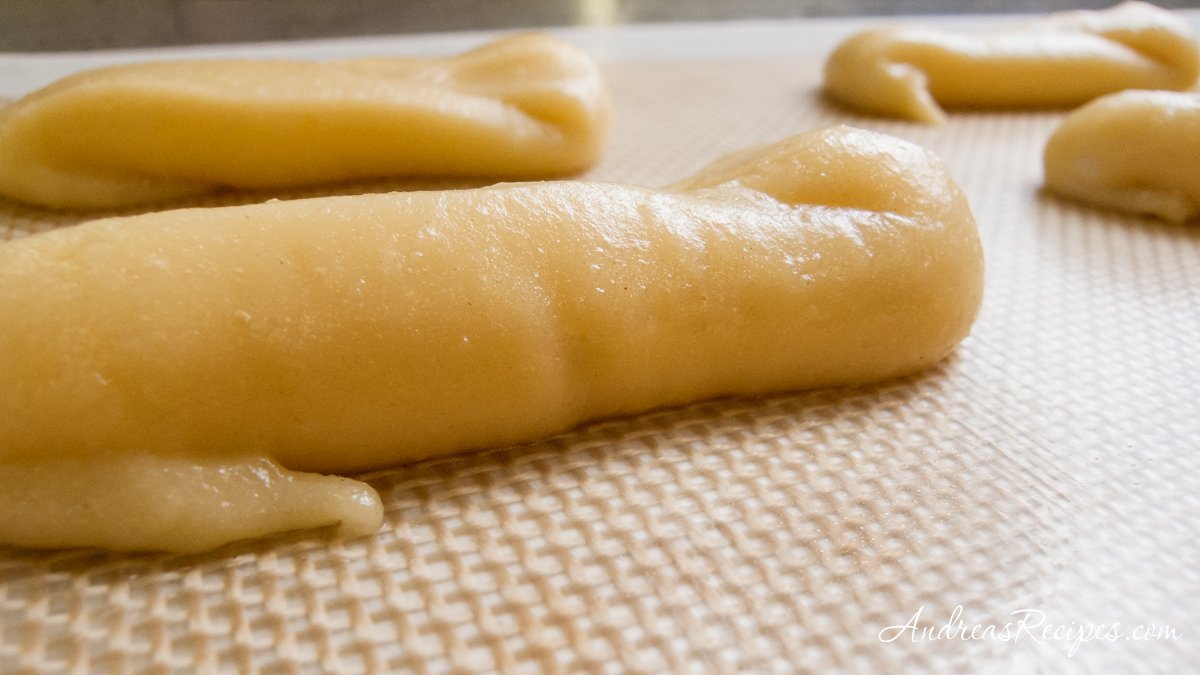
- Fill a large pastry bag (or gallon size plastic storage bag ala Alton Brown) fitted with a ⅔ (2cm) plain tip nozzle with the warm cream puff dough (I just cut a hole about 0.75 cm across). Pipe the dough onto the baking sheets in long, 4 to 4½ inches (about 11 cm) chubby fingers. Leave about 2 inches (5 cm) space in between each dough strip to allow them room to puff. The dough should give you enough to pipe 20-24 éclairs. (Note: Or you can follow the tip above which suggests piping one long line of dough. Freeze until partially solid, then cut into the perfect length.) If you hand pipe each éclair, you might get a little flourish of dough on top or on the side of each one. Just wet your fingertips and press them down, otherwise you will have little points on the baked eclairs.

- Slide both the baking sheets into the oven and bake for 7 minutes. After the 7 minutes, slip the handle of a wooden spoon into the door to keep in ajar. When the éclairs have been in the oven for a total of 12 minutes, rotate the sheets top to bottom and front to back. Continue baking for a further 8 minutes or until the éclairs are puffed, golden and firm. The total baking time should be approximately 20 minutes. (Note: I found that 20 minutes was not nearly long enough for my oven. After some experimenting and fallen eclairs, I settled on 27 minutes as being the perfect amount of time for my oven.)
- Allow the eclairs to cool and rest for several hours before filling. Keep in a cool, dry place.
Assembly
- Slice the cooled éclairs horizontally, using a serrated knife and a gently sawing motion. Set aside the bottoms and place the tops on a rack over a piece of parchment paper.
- The glaze should be barely warm to the touch (between 95 – 104° F/35 – 40° C, as measured on an instant read thermometer). If you chilled your chocolate glaze, reheat by placing it in a bowl over simmering water, stirring it gently with a wooden spoon. Do not stir too vigorously as you do not want to create bubbles. Spread the glaze over the tops of the éclairs using a metal icing spatula. (I dunked the tops into the glaze and allowed some to drip off.) Allow the tops to set and in the meantime fill the bottoms with the pastry cream.
- Pipe or spoon the pastry cream into the bottoms of the éclairs. Make sure you fill the bottoms with enough cream to mound above the pastry. Place the glazed tops onto the pastry cream and wriggle gently to settle them.
- Serve the éclairs as soon as they have been filled and topped.
Nutrition
Serving: 1eclair | Calories: 262kcal | Carbohydrates: 23g | Protein: 4g | Fat: 17g | Saturated Fat: 10g | Cholesterol: 92mg | Sodium: 63mg | Potassium: 169mg | Fiber: 2g | Sugar: 14g | Vitamin A: 394IU | Vitamin C: 1mg | Calcium: 59mg | Iron: 2mg